Why did the public get kicked out of the EDA meeting while a developer and his staff went into the closed session? This is my question, but let me back this up a little to explain why this is such an important question…
The Economic Development Authority (EDA) is a state-required, Council-appointed Board in the City of Suffolk. The EDA Board meets once per month on the second Wednesday of the month at 4pm at City Hall. Aside from the City itself, and the School Board which runs under its own elected representation, the EDA Board is the only City Board that is permitted to buy, own, and sell land.
I try to attend as many meetings as my schedule permits, but sometimes it isn’t possible and despite the nature of this Board, with it being able to buy and sell land, and its ability to give out large grants, the EDA Board is NOT streamed, unlike many other city boards. If a member of the public can’t make it, they are left reading the meeting minutes after the fact. There are definitely things one learns being at the meeting that are NOT captured by the minutes.
I wasn’t able to attend this past August 12, 2026 EDA meeting, but I know someone that did. This person was even kind enough to take video during the meeting which I will share in this article. I also learned from this person that a well known developer named Bob Arnette and a former City Council member, Don Goldberg, attended this meeting as well.
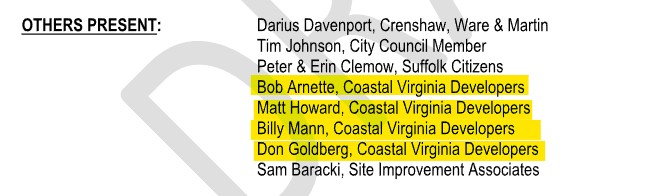
Mr. Arnette is a residential developer who is the owner of Coastal Virginia Developers. Some of his projects include the Lake Kilby rezoning in 2023 and the Manning Road rezoning from earlier this year. Care4Suffolk opposed both of these projects based on overcrowded schools and insufficient roads. Both projects were approved despite significant citizen opposition.
You might think, as I did, that the Economic Development Authority wouldn’t have much to do with residential development. After all, below is its purpose based on Virginia State code:
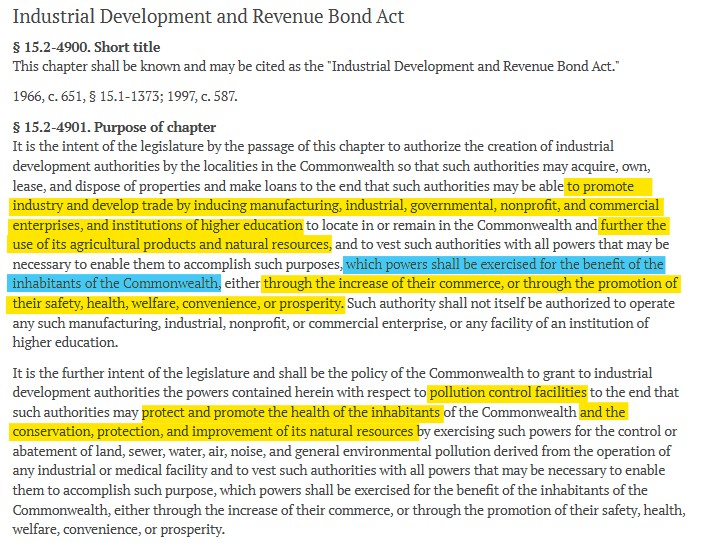
It speaks of industry, manufacturing, government, nonprofit, commercial enterprises as well as conservation and protection of natural resources. That is a pretty thorough list with one glaring exception – it doesn’t mention residential.
For some reason, the Suffolk EDA under the direction of City Manager Kevin Hughes has been very involved in residential development, despite the purpose of the EDA clearly having nothing to do with residential development. Examples of the Suffolk EDA involvement include: Obici Place, the Pointe at Harbour View, and more recently the failed Riversbend Project.
EDA meetings are open to the public and sometimes business owners, especially if they have been or would like to be the recipient of a grant, will come to the meetings. The concerning part of this is not that a developer and his associates were at the meeting, but rather they were permitted into the closed meeting, while citizens were asked to leave.
In the state code it is clear that there are certain uses for a closed session, or closed meeting, and in this August 12, 2026 EDA meeting, the DRAFT minutes state that the reason given is:
“A discussion or consideration of acquisition of real property for a public purpose, or of the disposition of publicly held real property where discussion in an open meeting would adversely affect the bargaining position or negotiating strategy of the Authority.” It also states that this is all in reference to Project Flood at “Suffolk Industrial Park”.
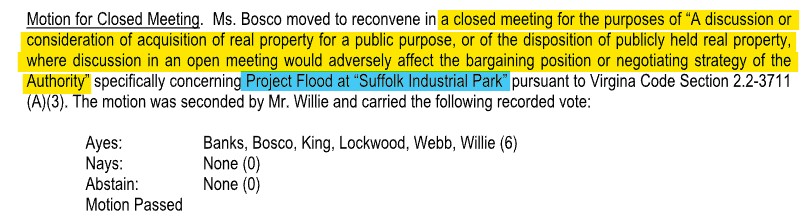
The EDA thought that allowing the public into this closed session would hurt the EDA’s bargaining position or negotiating strategy. I could understand that IF they hadn’t just allowed the developer and his associates in there while kicking the public out. Who else is the EDA negotiating with in this Project Flood if it isn’t Bob Arnette’s company? How does this make any sense?
If the EDA wanted to have the developer there to present information, fine, but then why were members of the public requested to leave during this portion? In fact, Mr. Goldberg was overheard saying to Mr. Arnette while entering the room, “Do you have the thumb drive?”
The business of the EDA is SUPPOSED TO BE OPEN TO PUBLIC INSPECTION. The EDA is not a business that can keep its plans private. The EDA is a government body subject to the Freedom of Information Act of 1967. By law, their business HAS to be open to the public except in very limited circumstances. They quote one of these allowed reasons, but that reason absolutely does not hold in this case. You can’t argue that the public can’t know because it might hurt the EDA’s bargaining position at the same time that the EDA has invited to the table, the very people with whom they are bargaining.
If you don’t believe me that there is something wrong with this, listen to the words from an EDA Board member who has his own concerns. The video below is a video taken by a member of the public during the meeting, before the closed session.
The speaker is Will Webb, an EDA Board member, and he also happens to be a lawyer. He is speaking BEFORE the closed meeting even came up. He is talking about previous closed sessions, multiple previous closed sessions, in which he believes these exemptions were used improperly. He mentions that he has even brought this issue before the Board previously. Here is a quote from Will Webb:
“…I have a couple of concerns. At that meeting [in July] we invoked Virginia Code § 2.2-3711.A3 to go into closed discussion. However, looking back at that, that invocation, in my opinion, was likely improper and no closed session should have been called. That specific exemption is strictly intended for situations where ‘discussion in an open meeting would adversely affect the bargaining position or negotiating strategy of the public body.’ In our discussion, in my opinion there simply was no bargaining or negotiating strategy at play there.”
Mr. Webb goes on to say that, “Far too often, we go into closed sessions and receive briefings on items that are not closely enough related to the exemption we stated in the motion.”
He then cautions the EDA body to make sure that they are careful with their use of the exemptions. He went on to say that Suffolk has had three cases go to Virginia Supreme Court regarding FOIA and the result is that the city, or the board members, ended up coming out on the losing side of those rulings. He states, “The court has actually admonished [other city boards] in the past for their FOIA violations.” He then reiterated the need for the EDA to be cautious with the exemption to make sure it is following what the Virginia code allows.
Keep in mind, this statement by Mr. Webb happened BEFORE the EDA went into the closed session.
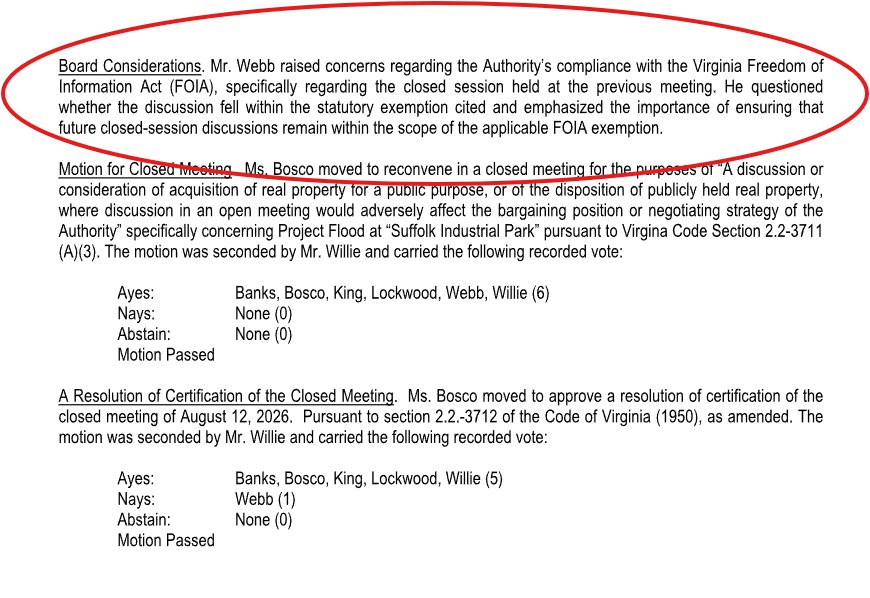
The Board hears Mr. Webb and then proceeds on to their next agenda item, which is the closed meeting for Project Flood. At this point, the public was asked to leave (to preserve the Board’s bargaining position,) but the EDA allowed a developer and his associate into this closed session (the very people with whom the Board will be negotiating.)
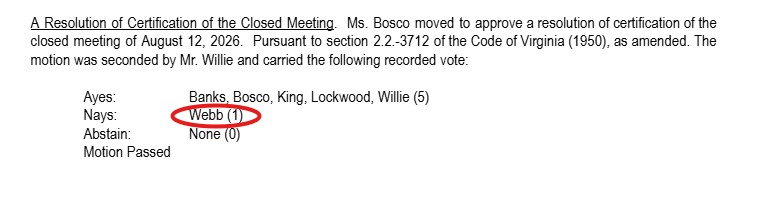
I was not there and can’t know what Board Members were thinking, but the record shows that Mr. Webb, who earlier in the meeting expressed concerns about misuse of exceptions, voted against certifying the Closed Meeting.
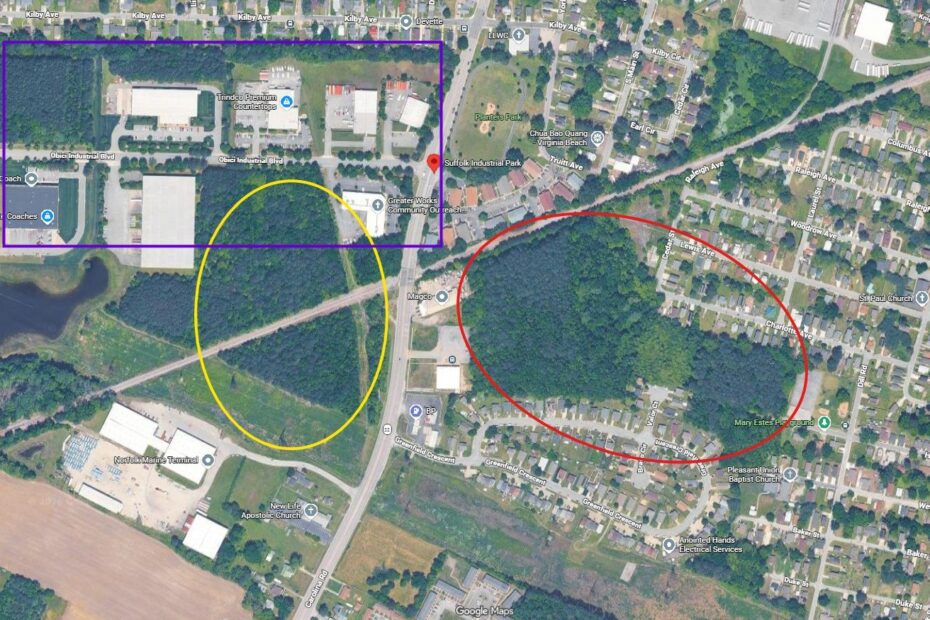
I have no real information about Project Flood, other than its being mentioned with “Suffolk Industrial Park”. Since it was a closed session, I also can’t get any information through a FOIA request, as the exemption prohibits public access. Below is what I found using google maps and the City’s property search website:
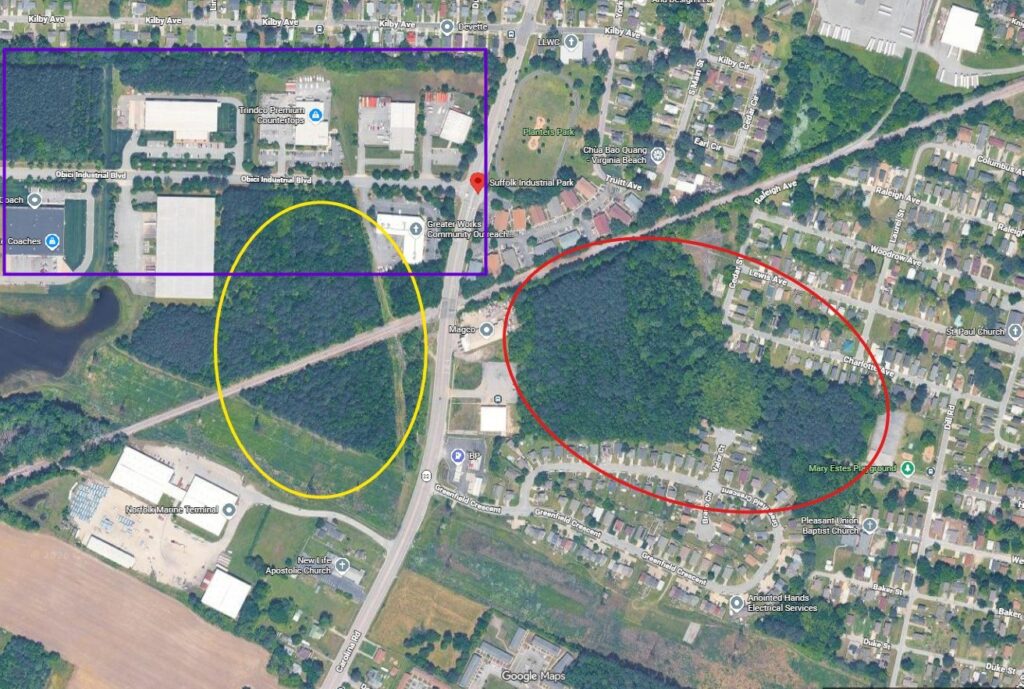
The purple rectangle is the approximate location of the Suffolk Industrial Park on Carolina Road. The yellow circle is land that is owned by the EDA. The red circle is land that is owned by Bob Arnette at Virginia Coastal Developers. This land owned by the developer was rezoned 2024 under the residential development named Parkwood to residential urban density, for a maximum of 235 townhome or multi-family units.
How does all this tie together? Honestly, I’m not sure. The item was referred to as Project Flood – is Mr. Arnette having storm water problems? At the Planning Commission Meeting on March 19, 2024, when there was a public hearing for the rezoning of Mr. Arnette’s property, neighbors expressed concerns for the rezoning, including flooding issues.
The EDA owns land across the street from the developer. How do these connect? I don’t know. I could be completely wrong about which parcels are even being discussed. I also don’t know if Project Flood is the EDA selling land to the developer, buying land from the developer, or some other type of deal like in the Riversbend Project, which failed to pass City Council, but which originally included the EDA allowing a developer (Ryan Homes) to use EDA land indefinitely – for free.
I don’t have any more information to share with you BECAUSE the EDA put this exchange behind in a closed meeting. The question is, was the EDA Board going into this closed meeting, specifically going into the closed meeting with the developers that it was negotiating with, consistent with FOIA law? That closed session was supposed to allow for free discussion among Board members, and maybe city staff, to discuss bargaining strategies. Instead, that closed session served to remove the public from the talks between the Board and the developers. That is NOT what these FOIA exemptions were designed for. From Mr. Webb’s speech to the Board, it doesn’t sound like this was the first time the closed session was used for this purpose (keeping the public unaware). I doubt it will be the last.