
Residential rezoning applications may contain a proffer of a certain dollar amount that is promised to the city to help pay to “expand school capacity.” This is voluntary and the applicants are not required to include it. Proffer amounts can vary, but there is a standard formula that is traditionally used. Hopefully, this article will shed some light on the school proffers: what they are, what they aren’t, and why sometimes this works out to be a bad system for the citizens, particularly the school aged ones. The proffers listed in the current Riversbend rezoning application will be used to provide a relevant and timely example.
To start with, school proffers are only offered if the new residential development will add students AND if the added students will cause the corresponding schools to exceed their capacity. The proffers are not for other schools in the system that are overcrowded. They are only for the impacted schools that those new homes will be zoned to attend.
School proffers are not used to make updates to an existing school, unless it is an expansion to allow for added capacity. The school may really need a new HVAC system or upgrades in technologies, but that is not how the proffers are to be used – the state is very clear on this.
It is also worth mentioning that school proffers are made in today’s dollars, but the city doesn’t receive the money until a home is built and the city has issued a certificate of occupancy. If the rezoning application was filed in 2022, approved for rezoning in 2023, but is not built until 2028, the amount of proffers are in 2022 dollars, with no increase for inflation. Additionally, if the city builds a new school in 2026 and increases capacity before those 2028 homes are built, the developer can go back to the city and get the proffers removed because there is no longer a need to increase capacity.
Student Generation
Let’s look at how school proffers are traditionally calculated. First, we have to calculate the student generation of the project. Below is the table that is used to determine how many students a given residential development will produce:
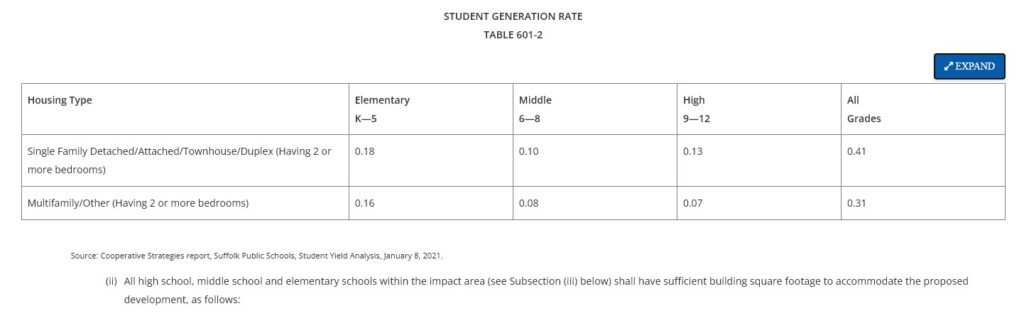
This table is found in Suffolk’s UDO (Unified Development Ordinance) under SEC. 31-601. – ADEQUATE PUBLIC FACILITIES, table 601-2. Single-family homes (whether attached, detached, townhomes, or duplexes) all are considered to produce students at the same rate. Multi-family units, like apartments, are considered to produce students at a slightly lower rate. The rate is an estimate. When a developer is building, they have no way to know exactly how many students any given home will have. The city uses an average of aggregate data that gives a good approximation. Over time these are reassessed because they do change (just like families used to average more children per family than they do today.) The City examined this most recently in the 2021 Student Yield Analysis.
As you look at the chart, you will notice that elementary school, middle school, and high school all have a different rate. That is because there are 6 years of elementary school (grades K-5), three years of middle school (grades 6-8), and four years of high school (grades 9-12). The actual rate is about 0.03 students per grade. So the elementary school is 0.03 x 6 = 0.18 and that’s where the rate comes from.
Let’s look at Riversbend’s student generation. This development is a little more complicated because it is proposing both single-family homes and condos (which would fall under the multi-family/other category.) These condos are specifically designated as age-restricted for owners that are 55+ years old.
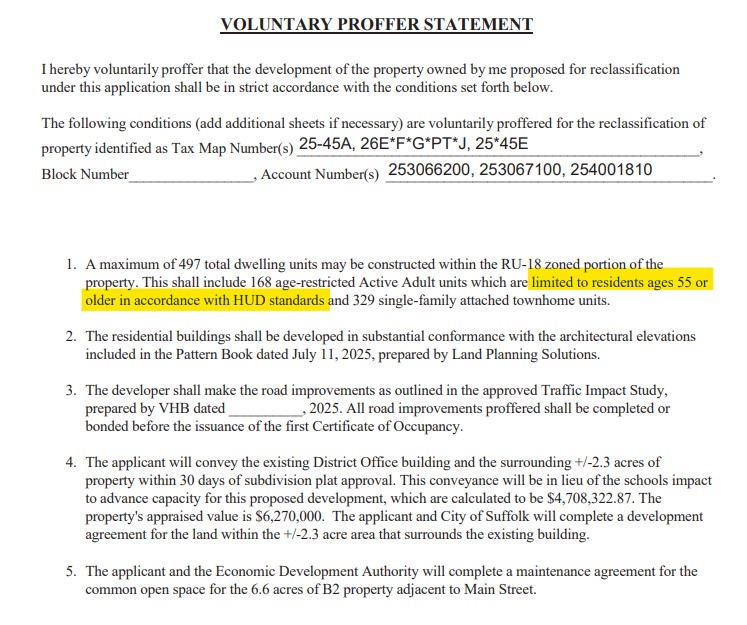
Above is the Riversbend Proffers and #1 states that they will be limited to HUD standards. Interestingly, HUD Standards do not eliminate the possibility of students living in the home. That is, HUD does not prohibit them, and in fact, it only requires one person in the home to be 55 years old AND it only requires it from 80% of the households. Twenty percent of those 168 condos, or about 33 of them won’t require the age restriction under the HUD standard. And with only one person needing to be 55 years old, it is conceivable (and even likely) that at least some of the homes may have children living there. Some parents with school-aged kids are 55+ years old. Additionally, some grandparents are the guardians of grandchildren. Below is the text of HOPA (Housing for Older Persons Act), as passed, and the basis for the HUD standard.
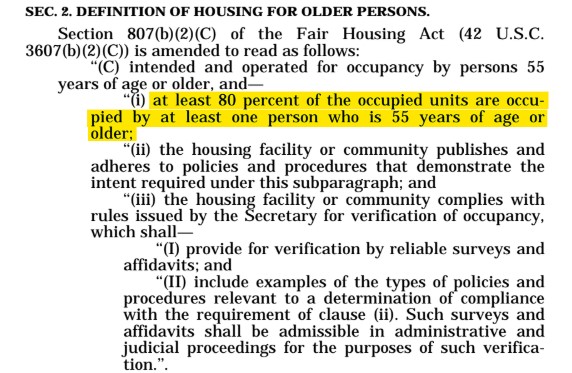
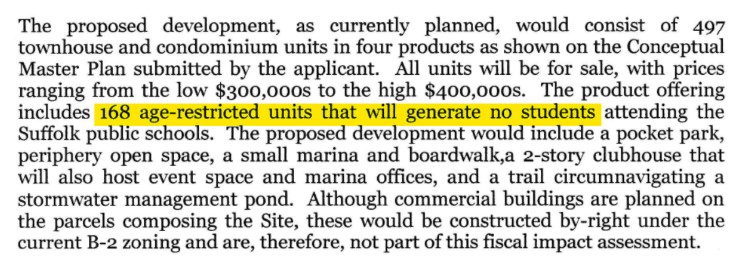
The Riversbend fiscal analysis states that the condos won’t add any students to the schools, but considering that they are using the HUD standard, they can’t actually guarantee that.
What I have done is calculate what the student generation rate is with no students coming from the condo (not probable) and with the rate expected from multi-family homes (also not probable). Somewhere in the middle lies the answer.

This first table shows the generation rate for the single-family homes only. Notice that the generated numbers from the developer are very different from mine. The developer’s fiscal analysis does not show how they came up with these numbers, but I will show you how I did.
There are 329 single-family homes. We both agree on that at least. Using the Generation Rates from 601-2, we calculate the following student generation:
#SFH (329) x Elementary School (ES) rate (0.18) = 59.22, round to the nearest whole student = 59 ES students
We repeat this for the Middle School (MS) and High School (HS):
329 x MS rate (0.10) = 32.9., rounded to 33 MS students
329 x HS rate (0.13) = 42.77, rounded to 43 HS students
The developer landed on 19 students per school. How did the developer come up with the same number of students for each level of school? At any rate, his calculations are way off and I stand behind my calculations.
If we repeat this process, but this time include the condos as if they will generate students at the same rate as other multi-family homes, then we get the following:

I applied the same formula as I did to calculate the single-family numbers, but used instead the lower rate for multi-family. I do acknowledge that the age-restricted (55+ years) condos will likely generate fewer students than the multi-family rate, but that it also will not be zero. This is an example where it would be good to have a more specific rate that accounts for the variance.
Subtract By-Right Student Generation
If the current zoning of a property would already allow the developer to build a certain number of houses by-right, then those students get subtracted and don’t count as part of the student generation in the school proffers.
For instance, if a developer wants to rezone 100 acres, from RE (Rural Estate) to RC (Residential Compact), the RE zoning designation already allows the developer to build, by-right (with no rezoning necessary) at a density of 0.30 for a total of 30 houses. Those 30 houses are already expected to generate 5.4 elementary students (using the SF rate of 0.18 for elementary school). If the land is successfully rezoned to RC, now the developer can build at a density of 7.3 homes per acre, for a total of 730 units. This would most likely be multi-family or some combination of multi-family and single-family units. Let’s just assume they are all multi-family to simplify this example (using the rate 0.16 for multi-family homes). Now the development is expected to generate 730 x 0.16 (generation rate) = 116.8 students.
The parcel was already expected to generate 5.4 elementary students, so this can be subtracted from the 116.8 elementary students to arrive at 111.4 added students, just for the elementary school.
Currently, the zoning for the old VDOT parcel is B-2, which is General Business zoning. B-2 is not expected to have any student generation, so for the Riversbend project, there is no by-right student generation to subtract.
School Impact
Let’s now look at how they determine school impact, which requires looking at each school level individually. Each residential parcel in the city is zoned for a specific elementary school, middle school, and high school. Each rezoning application identifies which schools serve that parcel.
If a development will add students to the elementary school, BUT that school is not at capacity, they don’t have to pay any proffers. For example, if a development will add 20 elementary students, but the elementary school that this development is zoned for has the capacity to absorb all 20 students, then no proffers are needed.
It might be the case that a development will add 20 students to the elementary school, but the elementary school can absorb only 5 students. That school is under capacity by 5 students. The remaining 15 students will cause extra strain to the school’s resources because they don’t have enough space for them. The developer can offer proffers to “expand capacity” for just those 15 students.
School Pipeline
Unfortunately, this all gets more complicated. The developer may not be the only developer looking to build in the area. In Suffolk, this is actually quite likely. Let’s make up an example to illustrate how this works:
Let’s take elementary “School A.” Five years ago, School A had a total capacity for 500 students, but only 475 students were attending. School A had the ability to absorb 25 more students. Five years ago, “Development X” was approved and these new homes will feed into School A. It is estimated that Development X will add 40 students. Development X proffered for the extra 15 students that it will add ABOVE School A’s capacity. Then two years ago “Development Y” was approved. It was estimated to add 30 students to School A. The developer for Y proffered for the full 30 students, because Development X was already in the pipeline – already rezoned and expected to be built and add to the student capacity.
In Suffolk, the RESIDENTIAL PIPELINE DEVELOPMENT report is updated periodically to keep track of all the developments that have been rezoned, how many housing units are left to be built, and which schools each will feed into. It is a 4 page document with about 100 developments listed on it. You can find the March 2025 document here and below is a small sample of what it looks like:
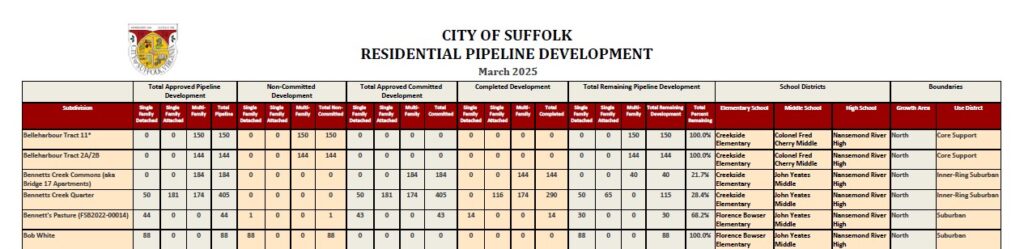
This spreadsheet shows how many total housing units can be built in each development. It even breaks it down as single-family detached, single-family attached, or multi-family.
It also shows if the development is committed or non-committed, meaning, has a site plan been approved or not. Sometimes construction can begin within a few months of the rezoning and sometimes there is no movement forward with the development for years or even decades.
The chart also shows how many units, if any, have been built so far. It then lists the remaining housing units and the percent remaining for the whole development. Lastly, it lists which schools each development is zoned for at each level.
In the specific example of the Riversbend project, the schools are: Hillpoint Elementary, Kings Fork Middle School, and Kings Fork High School. This rezoning hasn’t happened though, so it doesn’t appear on the list. However, Riversbend is like “Development Y” in my previous example, with many developments approved ahead of it that are already slated to generate a lot of students.
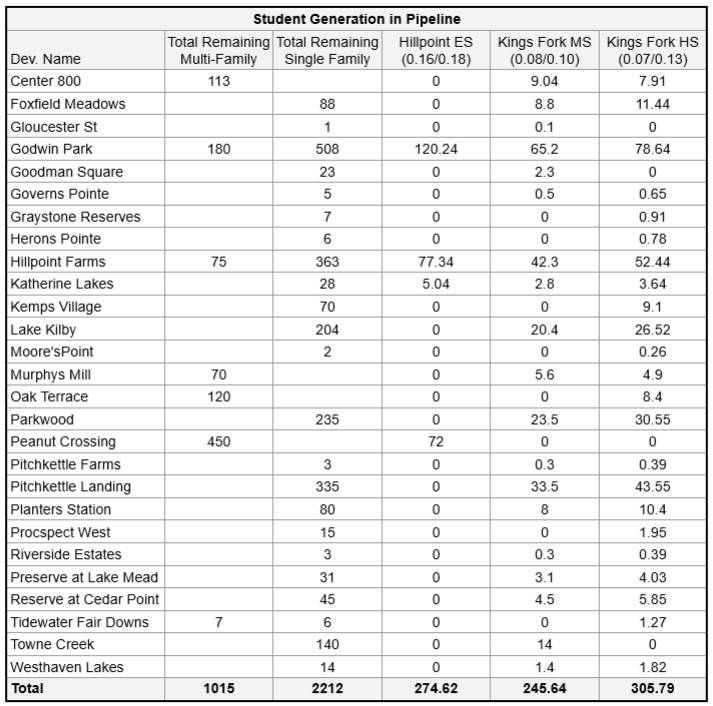
I used this pipeline report to figure out how many students will be generated for the same schools. First, I selected just the developments that impact the same schools that Riversbend will impact. It is more complicated than you might expect. Some of these developments only share a middle school with the Riversbend development, others share just an elementary school. Some even share all three of the schools. I had to look at each school on its own.
This chart below is my own creation. Any errors/omissions are my own mistakes (please feel free to let me know if you find any errors: care4suffolk@gmail.com).
In this chart, I have included every development currently on the city’s pipeline that shares at least one school with the proposed Riversbend development. Then I list the remaining housing units yet to be built, categorized by either single-family attached/detached/townhome/duplex or multi-family/other to match it with the student generation rates (way back from early in the article: table 601-2). Then, I multiplied the number of remaining units (by type) to its corresponding rate (by type). That number is the student generation expected from each of those developments for each of the schools Riversbend is zoned for. Some of the numbers are zero (0) because that school is not one of the same schools that Riversbend is zoned for. (I told you this was complicated.) You will also notice that some of the numbers are fractional (77.34 for example). I did not round to the nearest whole student because I am adding a large number of data points together. At the end, I will round to the nearest student. This will make it easier if anyone wants to check my math.
School Capacity
The next step is to figure out what the capacity of each school is, how many students are already expected to add to that capacity, and then, finally, how many students above capacity the Riversbend development will add, if it gets approved.
It turns out that a report with most of the needed information is already available:
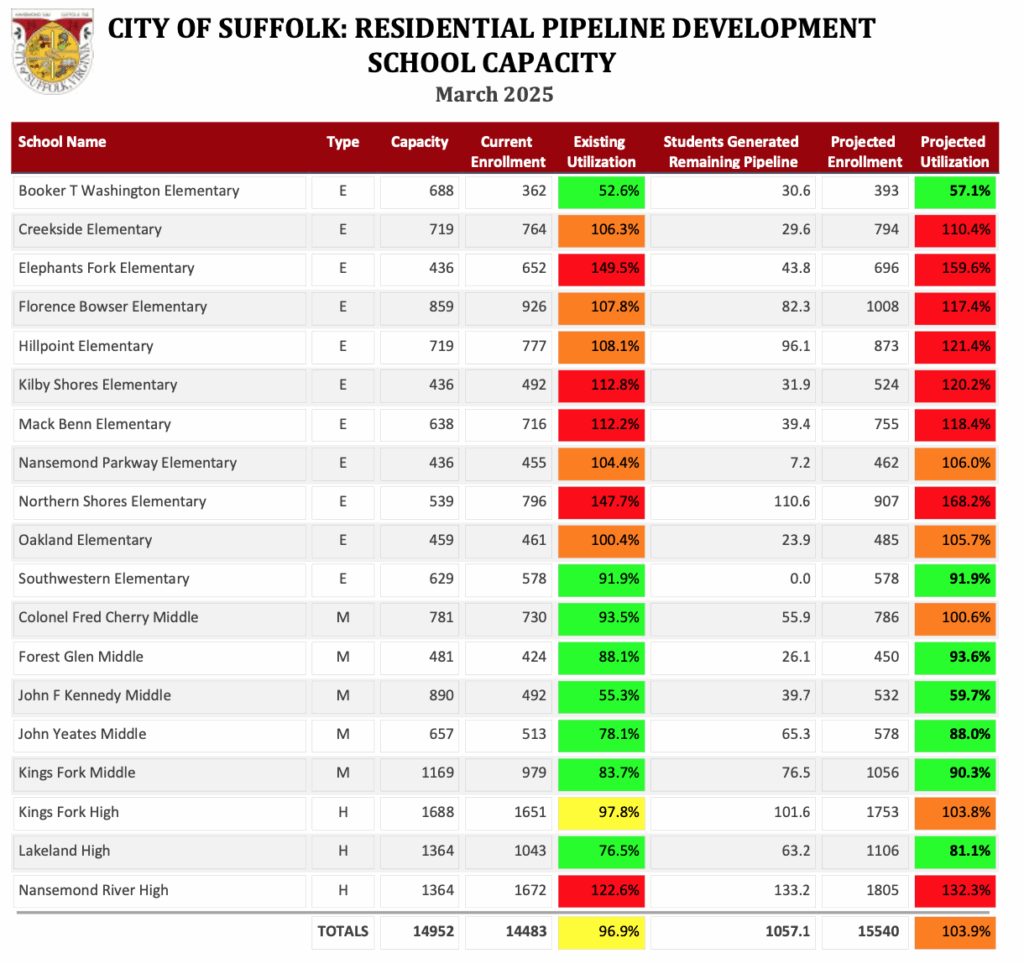
In the above City of Suffolk Residential Pipeline Development, School Capacity from March 2025, we can easily find each school, its capacity, how many students are currently attending, and the projected enrollment.
Below is my chart with the schools of interest, their capacity, current enrollment, projected capacity from the pipeline and then total enrollment with pipeline PLUS the addition of Riversbend.

If you compare, you will notice that the city’s numbers don’t match mine. Let me explain why. First off, all the capacities do match, because I took my school capacity numbers and enrollment numbers from the city’s chart. The current capacity percentages match, too, just slightly different rounding.
However, the city has significantly lower pipeline additions (projected enrollment). Where I have 306 expected students to be added by the pipeline to Hillpoint Elementary School, the city only has 96.1 expected. For Kings Fork Middle School, I have calculated 246 students from the pipeline, the city 76.5. For Kings Fork High School, I have 275 and the city only 101.6.
These are significantly different calculations, but I can explain the difference. The City of Suffolk has decided that if a development has been rezoned BUT is not committed (no site plan), they just don’t count the students that the non-committed development will generate. The city staff’s reasoning is that it might never be built. But because these developments can actually be built by-right, at any time. For planning purposes it is irresponsible to exclude these. Let’s look at a couple of examples of non-committed developments that the city is ignoring in their calculations.
Godwin Park, approved in 2020, will have 700 housing units when the project is completed, with an estimated 15 year time frame. As of the March 2025 pipeline, 12 homes have been completed with 131 homes in the committed category. Now this development was approved with the stipulation of building it in phases. Approved during the covid epidemic, it was probably slowed down initially, but building has definitely begun. However, if you are only counting committed developments, this one will only add another 119 homes, with 569 homes in the non-committed category. That is a LOT of homes to NOT count. And there is no legitimate expectation that they won’t eventually be built. Godwin Park will feed into all three Riversbend schools: Hillpoint Elementary School, Kings Fork Middle School, and Kings Fork High School.
Another example is Lake Kilby (now called Tillman Run). All 204 homes that were part of the rezoning application dating back 2022 (approved in 2023) are still in the non-committed category, yet they are likely to break ground on that development within the year. These 204 homes are not counted in the pipeline from the city. This development will feed into both Kings Fork Middle School and Kings Fork High School. Again, this development just recently went through the rezoning process and is working on a site plan now. Why is the city NOT looking to add these homes to understand the demand on the schools?
There are no dates listed in the Residential Pipeline Development report, so there is no way for someone looking at the report to readily know how long ago a development was approved. Because these developments have all been rezoned already, at any time a non-committed development could become a committed development. It is irresponsible to NOT include these homes while calculating school capacity. If each new developer only has to look at developments under construction, then some developers will pay less in proffers, as their impact will be evaluated to be lower than it will actually be when built. Maybe that is by design, but it is not good practice.
In my chart, I include all homes, committed and non-committed, and just subtracted out the ones already built (because presumably those students are already registered in the schools). If you look at my chart, you can see that each school is already set to be well over capacity by the time each already approved development gets built. They will be over capacity by very large amounts.
Hillpoint Elementary School is already at 108% capacity and with the pipeline, it will be at 150% capacity. That means for each classroom designed to accommodate 30 students, the school staff have to figure out where to put the extra 15 students! Add in the conservative estimate of Riversbend single-family homes only, and that jumps to 159% capacity. If we then look at what happens if the condo homes end up generating students – because that is a distinct possibility – we end up with capacity at 163%. How can the city and City Council, in good conscience, allow schools to be filled at 163% capacity. How are teachers expected to teach, students expected to learn, and all the other staff expected to adequately serve 1169 students in a facility designed for 777 students?
Below is my chart that shows the percent capacity of the schools if the condos also generate students:

Proffers
Now we get to the money. The city does not dictate a certain amount of money that is set for each student, instead it is based on the level of school that child is in. The State of Virginia went and took a look at state-wide data and they distilled the amount of money to be proffered based on location, the square footage of schools, and some other complicated aspects. The exact details on how it arrived at this average escapes me, but it becomes a pretty straight-forward calculation based on the level of school.
Proffers per student per level are as follows:
Elementary School = $35,900.55/student
Middle School = $42,065.60/student
High School = $59, 402.09/student
I plugged these values in to a spreadsheet to calculate what proffers SHOULD have been offered by the Riversbend developer:
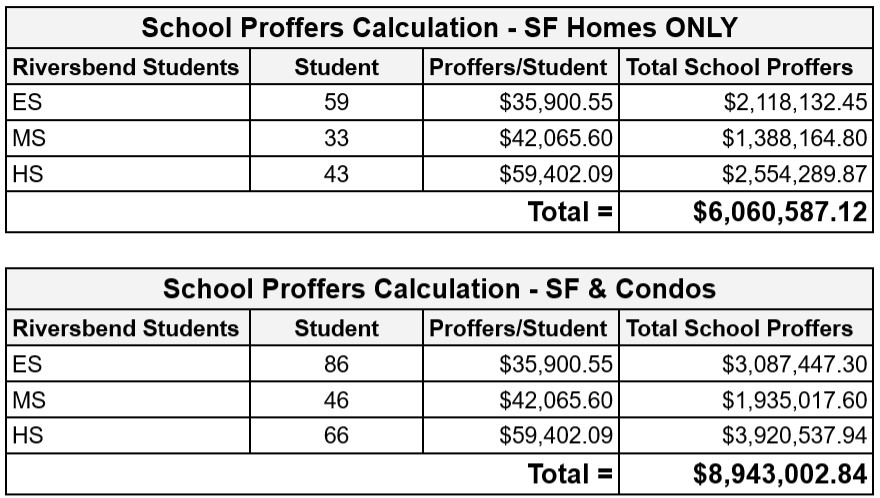
Whether you are using the conservative estimate or the higher one, the range is between $6 to $9 million. The Riversbend developer is not actually offering cash proffers. Instead, he has offered a trade. Below is the proffers statement again, but this time with the school proffers highlighted:
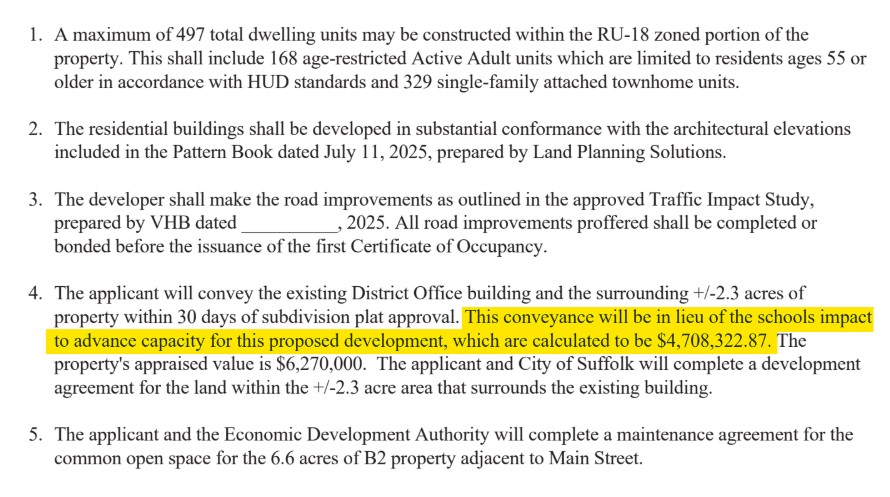
Here is what I can’t figure out. The developer’s fiscal analysis clearly stated that it had calculated the number of students generated to be 57. However, $4,708,322.87 divided by the 57 is equal to $82,602.16 per student. That is considerably higher than the high school amount (which is highest of the 3 school levels) of $59,402.09. That’s $23,200 more per student. They aren’t actually planning on paying that though. They are going to trade it for an old building they claim is valued at $6,270,000.
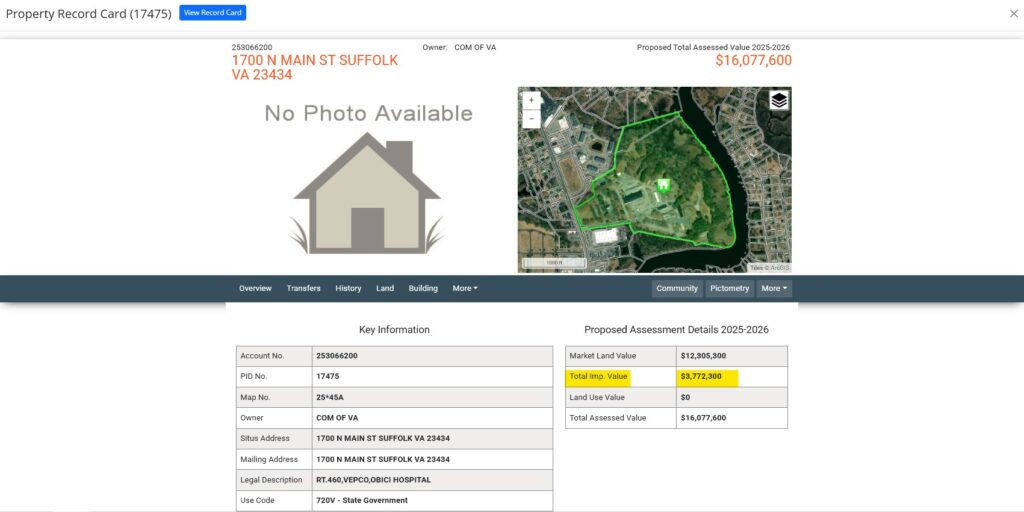
However, the building they are trading is valued at most $3.8 million, according to the City of Suffolk’s own assessment (see above). It is unclear from the city’s site if this one building is the only “improvement” being referenced on that site. Usually improvement values include things like a home, detached garage, out-buildings, etc., and there are about 30 other buildings on this property. At MOST this building is worth $3.8 million, but it could be worth significantly less.
The developer states that he had it appraised at $6.27 million, but this is the same developer that can’t figure out the student generation for the development. He may not be the most reliable source.
In the end, the amount of school proffers that should be offered for Riversbend is between $6 to $9 million, well above the estimated $4.7 million. There is a huge shortfall in school proffers here, especially when the city is receiving it in the form of an over-valued building.
In the end, the developer is trying to make the best deal for himself. I can’t blame him, it’s his job. It is the city’s job to make sure that the citizens, even the young, school-aged ones, receive a good deal, and that requires the city to start expecting developers to pay their fair share of the cost of the development. It is also the city’s job to recognize when the process isn’t working. Continually rezoning and ignoring the previously rezoned projects is putting a strain on our schools and students, and failing to adequately plan for the future.